Servo Stabilizer: Everything You Need to Know
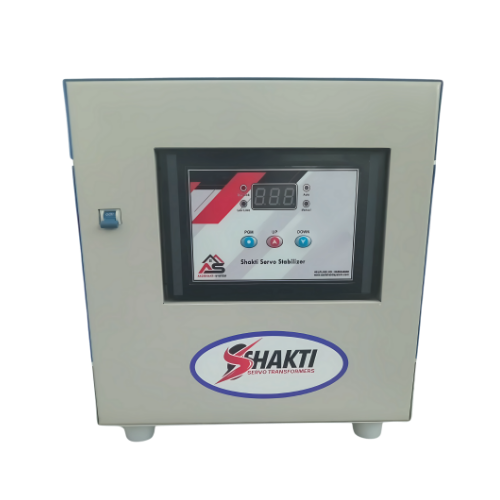
Servo Stabilizer
A servo stabilizer is an automatic voltage control device that delivers stable output voltage despite fluctuations in input power. It is used to protect electrical and electronic equipment from overvoltage, undervoltage, and power instability.
What is a Servo Stabilizer?
A servo stabilizer is an electromechanical voltage stabilizer that uses a servo motor and variable transformer to regulate voltage.
It continuously monitors incoming voltage and corrects it in real time.
The output voltage remains stable, accurate, and safe for sensitive equipment.
Servo stabilizers are known for high precision and reliability.
How does a Servo Stabilizer work?
- The stabilizer senses the incoming voltage through a control circuit.
- If voltage fluctuates, the controller sends a signal to the servo motor.
- The servo motor moves a carbon brush over the transformer winding.
- This movement adjusts the turns ratio of the transformer.
- The system instantly restores the output voltage to the required level.
This process is continuous and automatic.
Why is a Servo Stabilizer important?
- Protects equipment from voltage fluctuations
- Prevents damage caused by overvoltage and undervoltage
- Ensures consistent performance of electrical devices
- Extends the lifespan of appliances and machinery
- Ideal for areas with unstable or low-quality power supply
Servo stabilizers are critical for both residential and industrial environments.
Key facts and statistics
- Over 65% of electrical equipment failures in India are linked to voltage fluctuations (2025 power quality reports).
- Servo stabilizers offer voltage correction accuracy of ±1%, higher than relay stabilizers.
- Industrial servo stabilizers can handle loads from 1 kVA up to 10,000 kVA.
- Hospitals and data centers report up to 30% reduction in equipment downtime after installing servo stabilizers.
- The global voltage stabilizer market is projected to grow at 6% CAGR through 2026.
Common questions about Servo Stabilizer
Q1. What is the main use of a servo stabilizer?
Ans. A servo stabilizer is used to maintain stable voltage for sensitive and heavy electrical equipment.
Q2. How is a servo stabilizer different from a relay stabilizer?
Ans. Servo stabilizers provide smoother, more accurate voltage correction than relay-type stabilizers.
Q3. Is a servo stabilizer suitable for home use?
Ans. Yes. Servo stabilizers are suitable for homes with high-load appliances like ACs, refrigerators, and inverters.
Q4. What capacity servo stabilizer is required?
Ans. Capacity depends on total connected load, measured in kVA, including starting current of devices.
Q5. Does a servo stabilizer reduce electricity bills?
Ans. No. It does not reduce consumption but prevents power loss and equipment damage.
Q6. How long does a servo stabilizer last?
Ans. With proper maintenance, a servo stabilizer typically lasts 10 to 15 years.
Summary (TL;DR)
- A servo stabilizer provides precise and continuous voltage regulation.
- It works using a servo motor and variable transformer system.
- It protects equipment from voltage fluctuations and power instability.
- Used in homes, industries, hospitals, and data centers.
- Known for high accuracy, reliability, and long service life.
Conclusion
A servo stabilizer is a reliable solution for maintaining stable voltage in areas with frequent power fluctuations. It delivers precise voltage correction, protects sensitive and heavy equipment, and ensures consistent performance across applications. By using a servo motor–controlled transformer, it responds quickly to voltage changes and minimizes the risk of electrical damage. Whether used in homes, industries, hospitals, or data centers, a servo stabilizer improves equipment safety, reduces downtime, and extends operational life. For long-term voltage protection and dependable power quality, a servo stabilizer remains one of the most effective choices.