What Is a Servo Stabilizer? Everything You Need to Know 2026
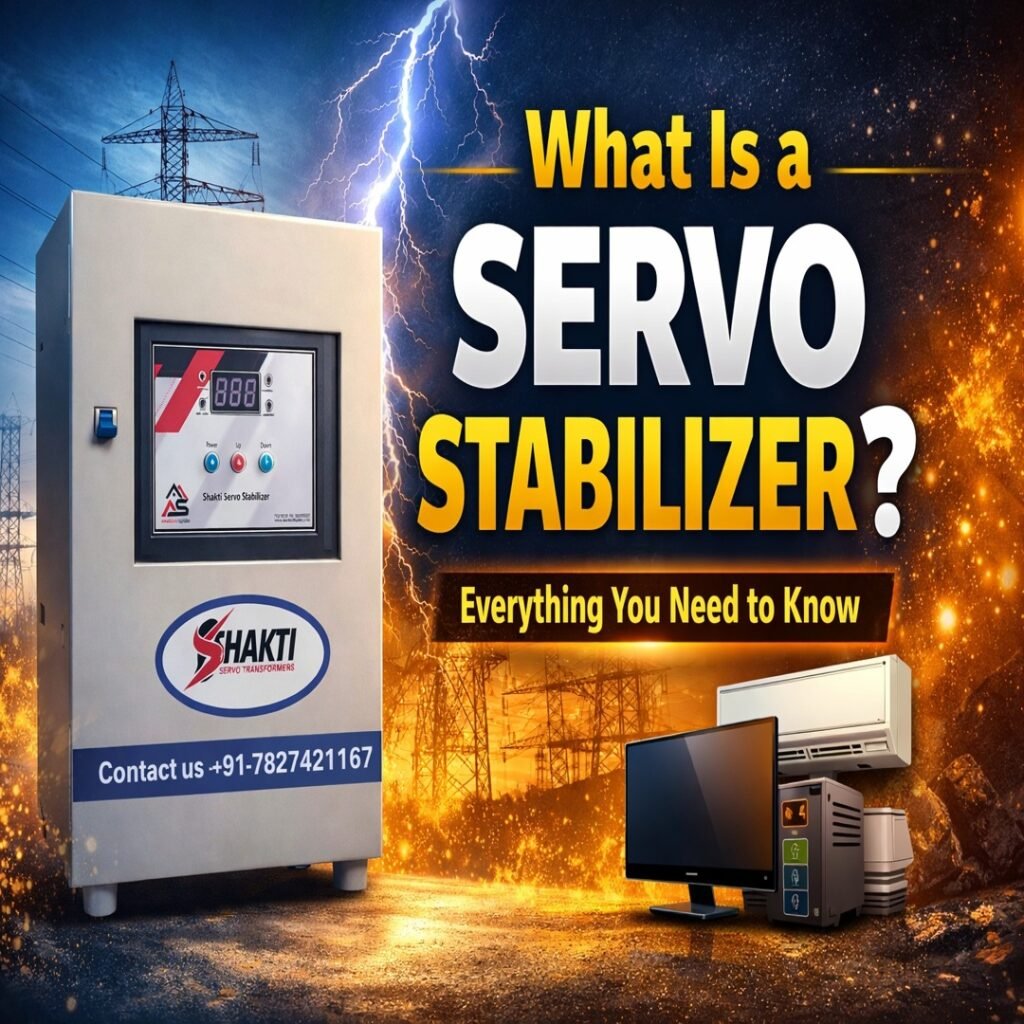
7.5 Kva Stabilizer
A servo stabilizer is a device that automatically regulates voltage fluctuations to deliver a constant power supply to electrical equipment.
It protects machines from damage caused by overvoltage, undervoltage, and power surges.
Industries, hospitals, offices, and homes use servo stabilizers to ensure stable and safe electrical performance.
What is a Servo Stabilizer?
A servo stabilizer is an automatic voltage correction system that maintains a steady output voltage despite input voltage variations.
It uses a servo motor mechanism to continuously adjust voltage levels.
It is designed for sensitive equipment that requires precise and stable power.
Servo stabilizers are commonly used in manufacturing units, medical facilities, IT infrastructure, and commercial buildings.
How does a Servo Stabilizer work?
A servo stabilizer works through continuous voltage monitoring and correction.
Step-by-step process:
- It detects fluctuations in incoming voltage through an electronic control circuit.
- The control circuit compares input voltage with the required output voltage.
- A servo motor adjusts a variable transformer accordingly.
- The transformer increases or decreases voltage to maintain a constant output.
- The corrected voltage is delivered to connected equipment.
This automatic adjustment happens within milliseconds, ensuring uninterrupted and stable power supply.
Why is a Servo Stabilizer important?
A servo stabilizer is important because voltage instability can damage expensive equipment.
Key benefits:
- Protects machines from overvoltage and undervoltage damage
- Extends equipment lifespan
- Prevents production downtime in industries
- Improves energy efficiency
- Reduces maintenance and repair costs
- Ensures consistent performance of sensitive devices
Voltage fluctuations are common in areas with unstable grids or heavy industrial loads. A servo stabilizer minimizes these risks.
Key facts and statistics
- Voltage fluctuations of ±20% are common in industrial zones in developing regions as of 2025.
- Equipment damage due to unstable power accounts for nearly 30% of electrical failures in small industries.
- Industrial servo stabilizers typically operate within an accuracy range of ±1%.
- The global voltage stabilizer market is projected to grow at over 6% annually through 2026.
- Hospitals and data centers report up to 40% fewer equipment failures when voltage regulation systems are installed.
- These figures show that voltage control systems are essential for operational reliability.
Common questions about Servo Stabilizers
1. What is the difference between a servo stabilizer and a normal stabilizer?
A servo stabilizer provides precise voltage correction using a motor-driven mechanism.
A normal stabilizer usually uses relay-based switching with less accuracy.
2. Where are servo stabilizers used?
They are used in industries, hospitals, data centers, CNC machines, printing units, and commercial buildings.
3. Can a servo stabilizer handle heavy loads?
Yes. Industrial models are designed to handle high-capacity loads and three-phase systems.
4. How fast does a servo stabilizer respond?
Most servo stabilizers correct voltage within milliseconds.
5. Does a servo stabilizer reduce electricity bills?
It does not directly reduce electricity consumption.
However, it prevents energy waste and equipment damage, which reduces operational costs.
6. Is maintenance required?
Yes. Periodic inspection of carbon brushes, servo motor components, and electrical connections is recommended.
Summary (TL;DR)
- A servo stabilizer maintains constant output voltage despite input fluctuations.
- It uses a servo motor and variable transformer for precise correction.
- It protects sensitive and high-value electrical equipment.
- It reduces downtime, maintenance costs, and equipment failure.
- It is widely used in industries, hospitals, and commercial facilities.