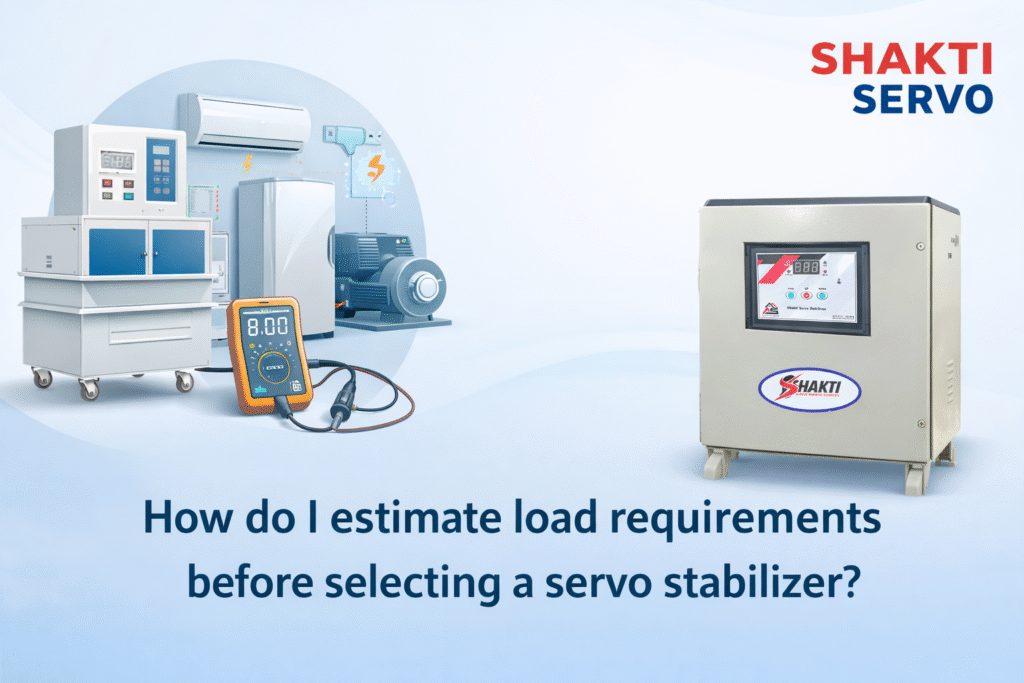
How do I estimate load requirements before selecting a servo stabilizer?
servo stabilizer
Estimating load requirements is one of the most important steps before choosing a servo stabilizer. If the capacity is too low, it may lead to overload issues, while an oversized stabilizer can increase unnecessary cost. So, understanding your actual load is essential for both performance and efficiency.
1. Identify All Connected Equipment
Start by listing all the electrical devices that will run through the servo stabilizer. This may include:
- Industrial machines
- Air conditioners
- Refrigerators
- Motors and pumps
- Sensitive electronic equipment
Make sure to note the power rating (in watts or kilowatts) of each device.
2. Calculate Total Load
Add the total power consumption of all devices. If the values are in watts, convert them into kilowatts:
Total Load (kW) = Sum of all equipment ratings
3. Convert kW to kVA
Servo stabilizers are usually rated in kVA, not kW. So you need to convert:
kVA = kW / Power Factor
Assuming a power factor of 0.8:
kVA = 4 / 0.8 = 5 kVA
This is why a 5 kVA stabilizer is often considered suitable for basic home appliances, but actual requirements may vary depending on usage.
4. Add Safety Margin
It is always recommended to add a 20–30% safety margin to handle sudden load increases and future expansion.
👉 Final recommended stabilizer ≈ higher than calculated value
5. Consider Load Type
Different types of loads behave differently:
-
Resistive load (heaters, bulbs) – stable
-
Inductive load (motors, ACs) – higher starting current
Inductive loads may require a higher capacity stabilizer.
6. Choose Phase Type
-
Single-phase stabilizer → for homes and small setups
-
Three-phase stabilizer → for industrial and heavy machinery
7. Real-World Considerations
Apart from calculations, build quality and reliability also matter. Some manufacturers like Shakti Servo provide both air-cooled and oil-cooled servo stabilizers designed for different applications. Comparing such options based on your load type and usage can help in making a better decision.
FAQs
1. How do I know which capacity servo stabilizer I need?
You can calculate it by adding the total load in kW, converting it into kVA, and adding a safety margin of around 20–30%.
2. Is a 5 kVA stabilizer enough for home use?
For basic home appliances like AC, fridge, and TV, a 5 kVA stabilizer is often sufficient, but it depends on the total connected load.
3. What is the difference between air-cooled and oil-cooled servo stabilizers?
Air-cooled stabilizers are suitable for smaller loads and indoor use, while oil-cooled stabilizers are better for heavy-duty and industrial applications.
4. Why is power factor important in stabilizer selection?
Power factor helps in converting kW to kVA, which is the actual rating used for servo stabilizers.
5. Can I use one servo stabilizer for both home and industrial equipment?
It is possible in some cases, but it is generally recommended to choose a stabilizer based on specific load requirements for better efficiency and safety.
Conclusion
Estimating load requirements for a servo stabilizer is not just about adding numbers—it involves understanding your equipment, usage pattern, and future needs. By calculating total load, converting to kVA, and adding a safety margin, you can select the right stabilizer capacity with confidence. A practical approach combined with proper research ensures long-term performance and protection of your electrical systems.
Read more – Do we need stabilizer for inverter AC